UGC ad examples: 7 types that work, with scripts
Seven UGC ad examples by type, from the selfie with the product to the price reframe. Each with what it looks like, a 3-line script, why it works and the mistake to avoid.
7 min read
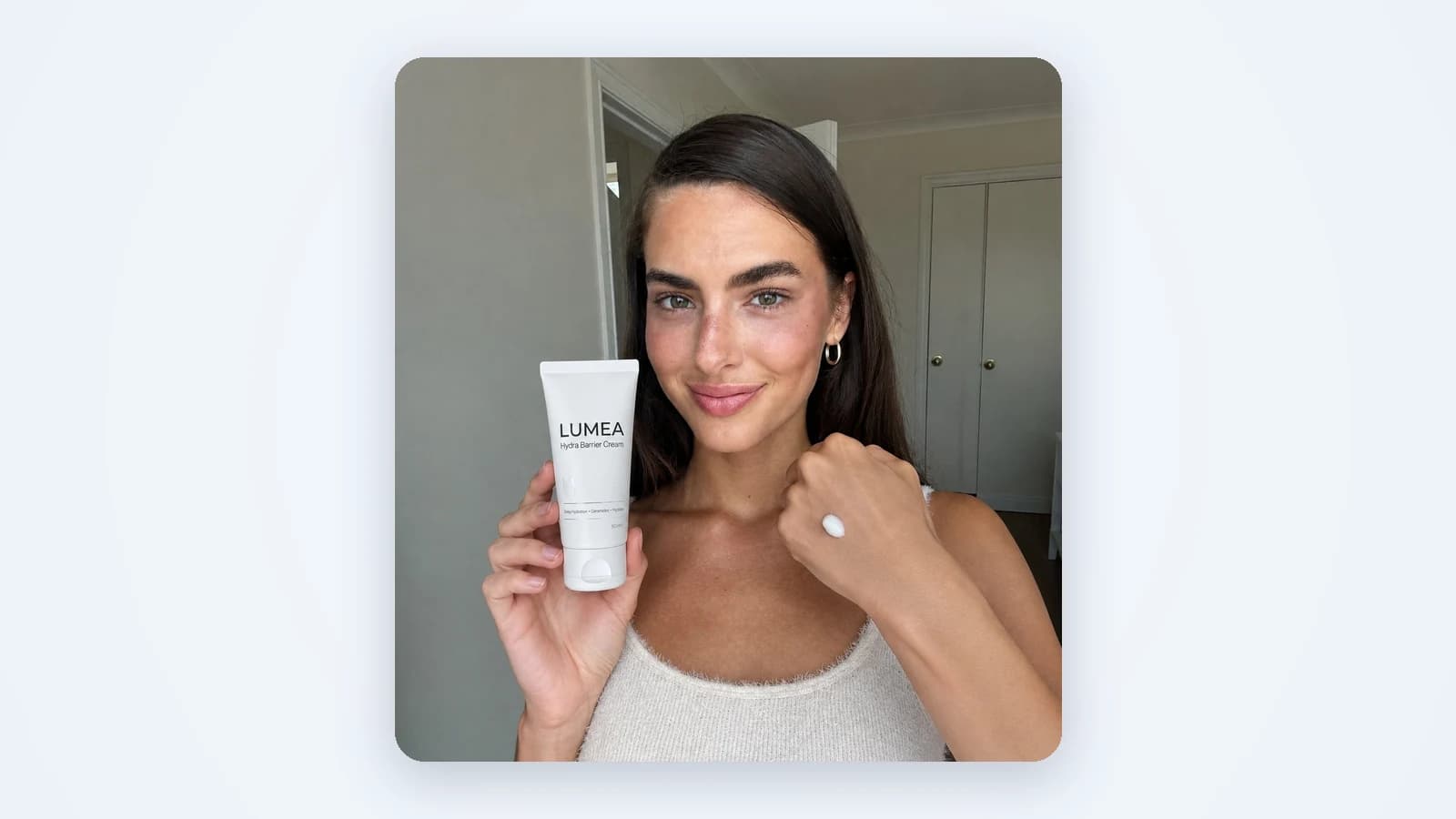
Good UGC ad examples are easy to admire and hard to copy, because nobody tells you why they work. This guide sorts them by type. For each one you get what it looks like, a 3-line script you can adapt, why it holds attention and the one mistake that kills it. At the end: how to make each type without hiring a creator.
UGC means user-generated content: a video that looks like a person filmed it on a phone, not like a studio spot. In an ad, that look buys you a few seconds of trust before the viewer decides to scroll.
Two rules behind every UGC ad example
First, show the product, don't lecture about it. In our internal research on about 290,000 organic Instagram and TikTok posts, a person giving advice straight to camera showed up roughly 40% less often among posts that beat their channel's usual views. Pretty product footage with no voice and no story did about as badly. These are patterns from organic posts, not a guarantee for paid ads, but the direction is clear.
Second, the first second decides. Open on something odd, a contradiction or the product already in use. If you need more openers, see our list of video ad hooks.
7 UGC ad examples by type
1. The selfie with the product in hand
What it looks like: a person holds the product next to their face, phone at arm's length, and talks like they're texting a friend. The label faces the camera.
- "This is the cream I keep on my desk now."
- "Thick, but it sinks in in a minute. No shine."
- "It's the white tube. Link's below."
Why it works: it reads as a recommendation, not a pitch. In our internal research, the selfie-with-product format was about 1.5× as common among organic posts that beat their channel's norm. Mistake to avoid: turning it into a talking head. If the product leaves the frame for ten seconds, it's an opinion video.
2. The reveal or unboxing held to the end
What it looks like: a closed box, a covered shelf or a half-finished setup. The product appears only in the last few seconds.
- "Everyone asks what's in the white box."
- "It's heavier than it looks. Hold on."
- "Here it is. Same color as on the site."
Why it works: people stay to see the payoff. In our own analysis, the reveal-at-the-end arc was about 1.6× as common among outperforming organic posts. Mistake to avoid: a slow open with nothing to wait for. Promise the reveal in the first line, then keep the shots moving.
3. The "1 or 2?" choice
What it looks like: two colors, two scents or two sizes side by side. The person asks the viewer to pick.
- "Sage or sand. I can't decide."
- "Sage hides coffee stains. Sand goes with everything."
- "Which one? Tell me in the comments."
Why it works: a direct question is an easy reply. In our internal research, a caption asking people to choose drew about 21% more comments on Instagram than the same channels' other posts. Mistake to avoid: asking for a "comment WORD" instead. That inflates comments without more reach.
4. The POV skit
What it looks like: "POV: you..." text on screen and a short, relatable scene. The product solves the joke, not the other way round.
- "POV: it's 7 a.m. and your bag ate your keys again."
- "Not anymore. Key clip, inside pocket, done."
- "The tote with the pocket. That's the whole ad."
Why it works: funny gets shared, and a familiar annoyance makes people watch to the end. Mistake to avoid: a skit where the product is a prop. If you can swap in any other brand, rewrite it.
5. The honest test
What it looks like: a simple test on camera. Water on the fabric. The case dropped on the floor. The candle after hours of burning.
- "Does it really hold up to water? Let's see."
- "Full glass. Wipe. Nothing came through."
- "Test it yourself. It's machine-washable too."
Why it works: proof on screen beats a claim in text, and the question opens a small loop the viewer wants closed. Mistake to avoid: a test the product could fail, or one you staged. Show only what is true for every unit you ship.
6. The price reframe
What it looks like: the price is split into something smaller and familiar: per use, per week, per wash. Or set next to something people already pay for.
- "[Your price] for a candle? Hear me out."
- "It burns about [hours] hours. That's [price per hour] an evening."
- "Less per evening than [something your buyer already pays for]."
Why it works: it answers the objection before it's typed in the comments. It also splits opinion, and opinion gets replies. Mistake to avoid: made-up math. Use your real price and your real numbers, or skip this type.
7. The step-by-step
What it looks like: the finished result first, then three short steps on screen, one phrase per step. Works for skincare routines, recipes, styling and setup.
- "This look takes three steps."
- "Serum first. Then cream. Then a dab under the eyes."
- "Two minutes, one bottle, all week."
Why it works: people save what they can repeat, and the result shown first gives them a reason to watch the steps. Mistake to avoid: too many steps for the length. In a 15-second video, three is the limit.
How to write a UGC ad script in 3 lines
Every UGC ad script in this guide has the same shape. Line one stops the scroll. Line two gives one concrete detail you can see. Line three tells people what to do or what to pick. Three lines fit in 15 seconds, which is plenty for UGC video ads on TikTok and Reels.
- The hook. A question, a contradiction or a "POV". No greeting, no brand intro.
- The proof. One thing the viewer can check with their eyes: texture, size, a test.
- The ask. "Link below", "which one?" or the price. Just one.
Read the lines out loud. If one sounds like a brochure, cut it. Many people watch with the sound off, so put every line on screen too.
How to make these UGC ad examples with Vendy
A real creator means a brief, a shipped sample, a wait and a reshoot when the offer changes. Vendy's UGC video replaces the shoot. To be clear: the creator is an AI avatar, not a real person. It talks to camera about your product or service in a phone-shot look.
- Start with one photo or a link. A phone shot of the product is enough. For a service, describe it in a sentence.
- Pick the face or let Vendy cast one.
- Edit the script. Paste one of the 3-line scripts above and put it in your words.
- Pick an opening frame. Vendy draws up to 4. The one you choose becomes the video.
- Download. 3 to 15 seconds, captions on, in 9:16, 1:1, 4:5 or 16:9.
Your real product stays as it is: same color, shape, label and logo. That matters most for the selfie, the reveal and the honest test, where the product is the point. For the reveal and the step-by-step, a product showcase video with hands and close-ups is often the better fit than a talking creator.
Since the creator is AI, keep the script about the product, not invented personal history. "Thick, but it sinks in fast" describes the product. "I've used it for a year" is a review that never happened. Run it as an ad from your brand, not as a customer testimonial. More on that in AI avatars for small business.
Vendy makes the creative. You upload it to Meta Ads Manager, TikTok Ads Manager or Google Ads and set budget and targeting there. For TikTok specifics, see the TikTok ad generator and our guide to TikTok AI ads. Every plan includes every tool, with full commercial rights for paid placements. See pricing.
How to test your UGC ad examples
Don't pick a favorite. Make three types for the same product, say a selfie, a choice and a reveal, and run them side by side. Keep the product and the offer the same, change only the type. The one that holds attention longest tells you which UGC ad ideas to make more of. For more formats beyond UGC, see AI video ads and these product video ideas, or go straight to AI UGC ads.
Takeaways
- The best UGC ad examples show the product in use and say one concrete thing about it. Advice to camera and pretty footage without a voice underperform.
- Seven types cover most needs: selfie with the product, reveal at the end, "1 or 2?", POV skit, honest test, price reframe and step-by-step.
- A UGC ad script needs three lines: hook, visible proof, one ask. Put every line in captions.
- With Vendy, an AI creator says your script in a 3 to 15 second video with your real product. Keep the lines about the product, not invented experience.
- Test three types per product and let the numbers pick.
Keep reading
All articles Video ads
AI video ads: types, lengths and how to make them
Creator clips, presenters over slides and product showcases: what each kind of AI video ad is for, which length and frame fits each platform, and how to make one from a product photo.8 min read
 Video ads
AI commercials: what a small seller can actually make
AI commercials are no longer just for big brands. Here is what they are, how they differ from a TV spot, and how to make one from a single product photo.6 min read
 Video ads
Affordable AI avatars for small business: who should use them and how
No camera, no actor, no studio. How a small or local business can use an AI presenter or an AI creator in its ads, where it works best, and what to keep honest.7 min read